 Virtual Varig Brasil
Important note
TAM Virtual Airlines is non-profit and has no legal or commercial relationship with the former TAM Linhas Aéreas or with any of the other companies mentioned on this page.
We are simply a group of aviation enthusiasts and admirers of this airline. We bring TAM's flight operations back to life in simulation software (FSX, Prepar3D, X-Plane and MSFS), flying offline and on the IVAO and VATSIM networks.
TAM Virtual Airlines
Our goal at TAM Virtual is to bring Brazil's regional airlines back to life, which is why we use the database of ANAC, Brazil's civil aviation authority.
We have the complete record of more than 14,000 real flights operated between 2000 and 2025. Together with the real fleet used by this group of airlines, realistic simulation is guaranteed! Many real models and registrations are available to fly, from aircraft of the airlines' early days such as the EMB110 and Fokker 27-500 to the modern Airbus A350-900 and Boeing 777-300ER.
We use a modern virtual airline system, with a custom ACARS, 24/7 support and all the technology you need for a smooth flight!
We are an official VATSIM partner, but you can fly online on whichever network you prefer, and if you want to fly offline, that is fine too! Here we are free to fly!
Our fleet is made up of many aircraft used by the regional airlines TAM, SETE, Passaredo, Trip and Pantanal. We have all of the airlines' regional, domestic and international routes, including vintage routes from the 1980s and 1990s.
If you want to fly freely, wherever you like, we have our fleet of executive aviation aircraft and helicopters and SETE Táxi Aéreo. In this mode, our pilots choose and are responsible for their own operation, setting their flight plan, origins and destinations anywhere in the world!
All together, we offer a large number of flights, a wide route network and a very flexible fleet for your simulation.
The history of TAM, Táxi Aéreo Marília
Here we pay tribute to the story of TAM's founder, Captain Rolim Amaro.
Táxi Aéreo Marília was founded in 1961 by ten single-engine aircraft pilots. At the time, they carried cargo and passengers in the states of Paraná, São Paulo and Mato Grosso.
Six years later, the group was bought by businessman Orlando Ometto and its headquarters moved to São Paulo, where it began carrying mail bags. In 1971, Captain Rolim Amaro, who had worked at the company when it was founded, was invited by Orlando Ometto to become a minority partner with 33% of the shares.
The following year he acquired half of the shares and took over management of the company, which in 1976 became simply TAM, by which time Rolim held 67% of the capital. Among the changes Rolim made, service returned to the interior of São Paulo, Paraná and Mato Grosso.
In the 1980s, as operations grew, the airline began flying the Fokker F27, replacing the EMB-110, and reached one million passengers carried in 1981. Always seeking to expand across Brazil, in 1986 it acquired the airline VOTEC, renamed BRcentral, taking TAM's operation to the Centre-West and North regions.
In 1990, Fokker delivered the first F50s to TAM and, in 1991, operations began with the Fokker 100. Shortly afterwards, TAM became the largest operator of this aircraft in the world.
In 1993, the novelty was its frequent flyer programme, which had no seat limits for award tickets, a pioneering move among airline mileage programmes.
Using its EMB110, Fokker 27, Fokker 50 and Fokker 100 aircraft, TAM began 1996 flying routes across the whole country and, after acquiring Lapsa (Líneas Aéreas Paraguayas), started its expansion across the continent. LAPSA was renamed TAM Mercosur.
With the operation growing, and planning to provide aircraft maintenance to other airlines, the company bought a 447-hectare site near São Carlos, in the interior of São Paulo, which today houses the LATAM Technology Centre, also known as LATAM MRO.
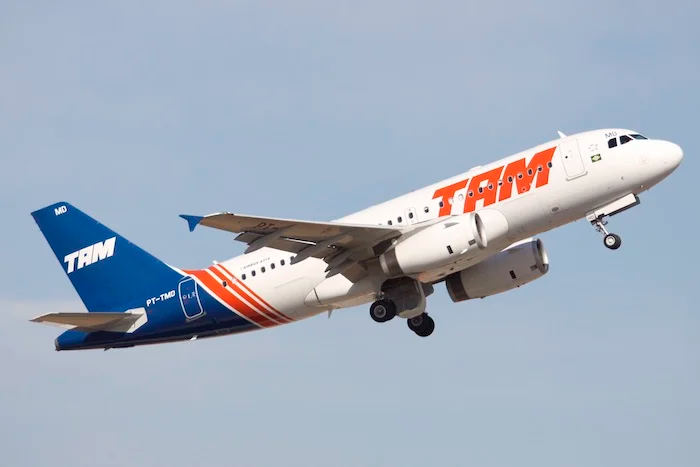
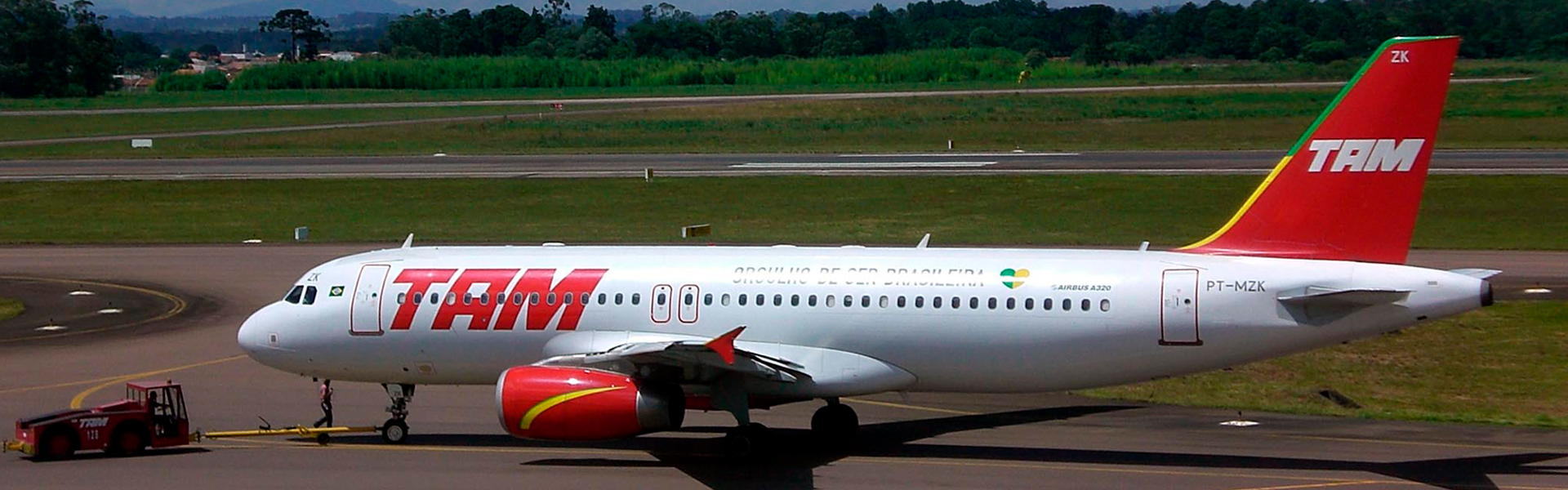
As Fokker ended its operations, and preparing for the new millennium, TAM restructured and began replacing its Fokkers with Airbus aircraft, ordering new A319s, A320s and A330-200s in 1996 and receiving them in 1998 (A330), 1999 (A319) and, in 2000, its first A320, PT-MZG.
With its Airbus A330s, the airline flew its first international flight, from São Paulo to Miami, and in 1999 launched its first route to Europe, to Paris. In 2004 it increased daily flights to the United States and Europe, reaching 24 weekly frequencies.
Around that time it also launched E-TAM, a kiosk that let passengers check in in just 10 seconds. It established itself as one of the major airlines in the market and signed a codeshare agreement with Varig; that year the company posted a profit of 174 million reais.
With the end of its turboprop operation approaching, and watching changes in the domestic market, it began an expansion strategy, signing a series of agreements with regional airlines (its partners Passaredo, Ocean Air, Total, TRIP and Pantanal) to form a regional alliance and fill the gap left by the flights no longer served by its F27s and F50s.
After the bankruptcy of VARIG, VASP and TransBrasil, a gap opened in the Brazilian market. In 2005, TAM took over VARIG's international routes to Buenos Aires, with five daily frequencies, Santiago, with one daily frequency, and New York, with two daily frequencies, and increased the Paris route to two daily frequencies.
The following year it started a new route to Miami from Manaus, and a route to London. In 2007, routes to Milan and Córdoba began. With international flights growing, TAM began a new fleet modernisation programme, ordering new Airbus A350 XWBs and Boeing 777-300ERs.
In 2008, TAM's board accepted the invitation and joined Star Alliance, as agreements already existed with several member airlines. The stay was short, however: in 2013 the LATAM Airlines Group was created, and one of the conditions was that both airlines belong to a single alliance. The choice was oneworld, but that too was short-lived: the partnership changed when the American Delta Air Lines bought 20% of the group, financed its exit from oneworld and moved its codeshare operations to SkyTeam, which Delta was already part of.
In 2019, the ICAO code TAM was retired. Since 2016 the company's website had used the new identity, and the fleet gradually left TAM's red livery behind, replaced by the white LATAM livery; the TAM brand ended operations in 2023. Still, for those who enjoy listening to ATC, the TAM callsign can still be heard on frequencies across Brazil.
Updated on Nov 15, 2026